Produit de Kronecker

Un article de Wikipédia, l'encyclopédie libre.
Aller à : Navigation, rechercher

En mathématiques le produit de Kronecker est une opération portant sur les matrices. Il s'agit d'un cas particulier du produit tensoriel. Il est ainsi dénommé en hommage au mathématicien allemand Leopold Kronecker.

Sommaire

Définition [modifier]

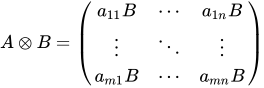
Soient A une matrice de taille m x n et B une matrice de taille p x q. Leur produit tensoriel est la matrice A \otimes B de taille mp par nq, définie par blocs successifs de taille p x q, le bloc d'indice i,j valant (a)_{ij} \cdot B

En d'autres termes

 A \otimes B = \begin{pmatrix} a_{11} B & \cdots & a_{1n}B \\ \vdots & \ddots & \vdots \\ a_{m1} B & \cdots & a_{mn} B \end{pmatrix}

Ou encore, en détaillant les coefficients,
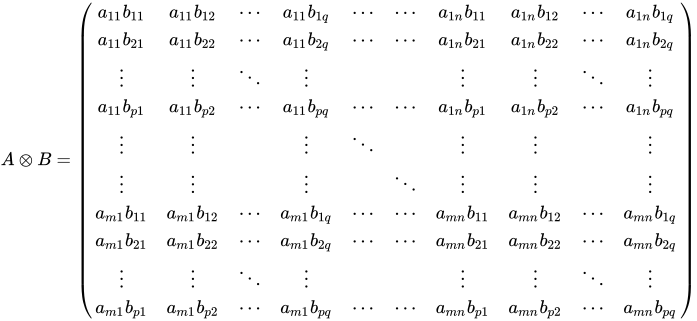
A \otimes B = \begin{pmatrix}
   a_{11} b_{11} & a_{11} b_{12} & \cdots & a_{11} b_{1q} & 
                   \cdots & \cdots & a_{1n} b_{11} & a_{1n} b_{12} & \cdots & a_{1n} b_{1q} \\
   a_{11} b_{21} & a_{11} b_{22} & \cdots & a_{11} b_{2q} & 
                   \cdots & \cdots & a_{1n} b_{21} & a_{1n} b_{22} & \cdots & a_{1n} b_{2q} \\
   \vdots & \vdots & \ddots & \vdots & & & \vdots & \vdots & \ddots & \vdots \\
   a_{11} b_{p1} & a_{11} b_{p2} & \cdots & a_{11} b_{pq} & 
                   \cdots & \cdots & a_{1n} b_{p1} & a_{1n} b_{p2} & \cdots & a_{1n} b_{pq} \\
   \vdots & \vdots & & \vdots & \ddots & & \vdots & \vdots & & \vdots \\
   \vdots & \vdots & & \vdots & & \ddots & \vdots & \vdots & & \vdots \\
   a_{m1} b_{11} & a_{m1} b_{12} & \cdots & a_{m1} b_{1q} & 
                   \cdots & \cdots & a_{mn} b_{11} & a_{mn} b_{12} & \cdots & a_{mn} b_{1q} \\
   a_{m1} b_{21} & a_{m1} b_{22} & \cdots & a_{m1} b_{2q} & 
                   \cdots & \cdots & a_{mn} b_{21} & a_{mn} b_{22} & \cdots & a_{mn} b_{2q} \\
   \vdots & \vdots & \ddots & \vdots & & & \vdots & \vdots & \ddots & \vdots \\
   a_{m1} b_{p1} & a_{m1} b_{p2} & \cdots & a_{m1} b_{pq} & 
                   \cdots & \cdots & a_{mn} b_{p1} & a_{mn} b_{p2} & \cdots & a_{mn} b_{pq} 
\end{pmatrix}

Exemple [modifier]


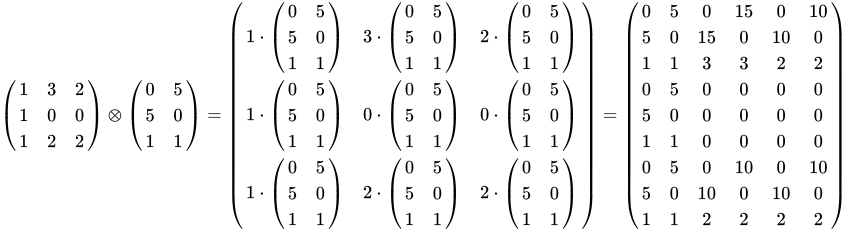
  \begin{pmatrix}
    1 & 3 & 2 \\
    1 & 0 & 0 \\
    1 & 2 & 2
  \end{pmatrix}
\otimes
  \begin{pmatrix}
    0 & 5 \\
    5 & 0 \\
    1 & 1
  \end{pmatrix}

= \begin{pmatrix}
 1  \cdot 
\begin{pmatrix}
    0 & 5 \\
    5 & 0 \\
    1 & 1
  \end{pmatrix}
& 3  \cdot 
\begin{pmatrix}
    0 & 5 \\
    5 & 0 \\
    1 & 1
  \end{pmatrix}
& 2  \cdot
\begin{pmatrix}
    0 & 5 \\
    5 & 0 \\
    1 & 1
  \end{pmatrix}\\
1  \cdot
\begin{pmatrix}
    0 & 5 \\
    5 & 0 \\
    1 & 1
  \end{pmatrix}
& 0  \cdot
\begin{pmatrix}
    0 & 5 \\
    5 & 0 \\
    1 & 1
  \end{pmatrix}
& 0  \cdot
\begin{pmatrix}
    0 & 5 \\
    5 & 0 \\
    1 & 1
  \end{pmatrix}\\
1  \cdot
\begin{pmatrix}
    0 & 5 \\
    5 & 0 \\
    1 & 1
  \end{pmatrix}
& 2  \cdot
\begin{pmatrix}
    0 & 5 \\
    5 & 0 \\
    1 & 1
  \end{pmatrix}
& 2  \cdot
\begin{pmatrix}
    0 & 5 \\
    5 & 0 \\
    1 & 1
  \end{pmatrix}
\end{pmatrix}

= \begin{pmatrix} 

    0 & 5 & 0 & 15 &0 & 10 \\
    5 & 0 &15 & 0 &10 & 0 \\
    1 & 1 & 3 & 3&2 & 2\\
    0 & 5& 0 & 0 &0 & 0 \\
    5 & 0 &0 & 0 &0 & 0 \\
    1 & 1&0 & 0& 0 & 0\\
    0 & 5 &0 & 10 & 0 & 10 \\
    5 & 0 &10 & 0 &10 & 0 \\
    1 & 1&2 & 2&2 & 2
 \end{pmatrix}

Propriétés [modifier]

Bilinéarité, associativité [modifier]

Le produit de Kronecker est bilinéaire et associatif : sous réserve de compatibilité des tailles pour A, B et C, on a les équations suivantes :


A \otimes (B+ \lambda\ \cdot C) = (A \otimes B) + \lambda (A \otimes C)


(A + \lambda\ \cdot B) \otimes C = (A \otimes C) + \lambda (B \otimes C)


A \otimes ( B \otimes C) = (A \otimes B) \otimes C

Le produit de Kronecker n'est pas commutatif ; cependant pour toutes A et B il existe deux matrices de permutation P et Q telles que  A \otimes B = P (B \otimes A) Q

Si de plus A et B ont la même taille, alors  A \otimes B et  B \otimes A sont équivalentes par permutation sur les vecteurs de la base :

 A \otimes B = P^{-1} (B \otimes A) P = {}^{t}\!P (B \otimes A) P

P est une matrice de permutation.

Propriétés sur le produit usuel [modifier]

On a la propriété suivante qui mélange les aspects liés au produit matriciel usuel et au produit de Kronecker :


(A \otimes B) (C \otimes D) = (A C) \otimes (B D)

On peut en déduire que  (A \otimes B) est inversible si et seulement si A et B sont inversibles, auquel cas : 

( A \otimes B ) ^ {-1} = A^{-1} \otimes B^{-1}

Spectre [modifier]

En utilisant la propriété précédente on déduit que si X et Y sont des vecteurs propres de A et B : A X = \lambda\ X et B Y = \mu\ Y, alors :


(A \otimes B) (X \otimes Y) = \lambda \mu (X \otimes Y)

Donc si  \lambda_{1}, ... , \lambda_{n} et  \mu_{1} , ... , \mu_{m} sont les valeurs propres de A et B, alors  \lbrace \lambda_{i} \cdot \mu_{j} , i = 1 ... n, j = 1 ... m \rbrace sont les valeurs propres de A \otimes B, en comptant la multiplicité.

En particulier :


\operatorname{Tr}( A \otimes B ) = \operatorname{Tr}( A ) \operatorname{Tr}( B )


\operatorname{det}( A \otimes B ) = \operatorname{det}( A )^{m} \operatorname{det}( B )^{n}


\operatorname{rg}( A \otimes B ) = \operatorname{rg}( A ) \operatorname{rg}( B )

Tr désigne la trace, det le déterminant et rg le rang de la matrice.

Transposition [modifier]

On a la propriété suivante sur la transposée : 

{}^{t} \! ( A \otimes B ) = {}^{t} \! A  \otimes {}^{t} \! B